
The Education of the Senses: Clinical Mentorship in the Mid-Century Ward
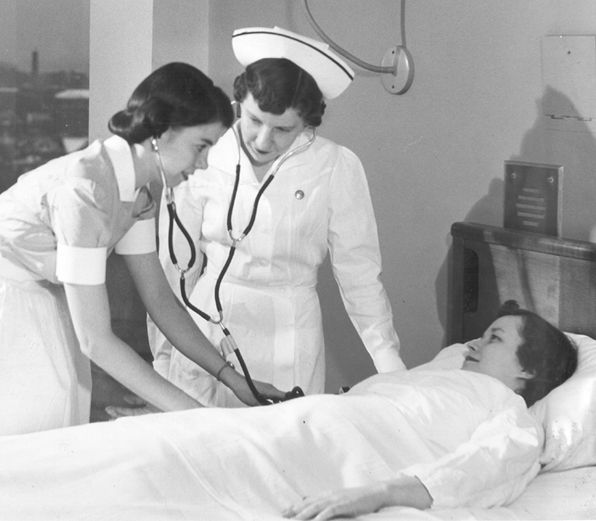
If the previous images captured the preparation of medicine and the vigilance of the bedside vigil, this third photograph reveals the mechanism by which those skills were passed down: the clinical apprenticeship. Here, we see a seasoned nurse supervising a student or junior nurse as she performs a fundamental physical assessment—taking a blood pressure reading. This scene, likely from the early 1950s, highlights the rigorous “hands-on” nature of nursing education before the advent of simulation labs and electronic diagnostic tools.
The Stethoscope and the Sphygmomanometer: A Manual Masterclass
In this era, a patient’s “vitals” were a product of the nurse’s manual dexterity and acute hearing. The junior nurse is shown using a manual sphygmomanometer (blood pressure cuff) and a stethoscope.
Unlike today’s digital cuffs that provide a reading at the push of a button, the mid-century nurse had to master the delicate art of the “mercury drop.” She would inflate the cuff, then slowly release the valve while listening for the Korotkoff sounds—the specific tapping noises that signal systolic and diastolic pressure. This required absolute silence and intense focus. The supervising nurse stands over her, not just to verify the number, but to observe the student’s technique: the placement of the diaphragm on the brachial artery, the speed of the pressure release, and the calm demeanor maintained in front of the patient.
The Hierarchy of the Cap
The visual distinction between the two nurses is subtle but significant, particularly in their headwear.
-
The Student/Junior Nurse: Often wore a simpler cap or no black stripe.
-
The Senior/Head Nurse: Usually wore a cap with a distinct black velvet band or a unique fold that signaled her years of experience and rank.
In the mid-20th century, the hospital was a strictly hierarchical environment. Learning happened “at the elbow” of a superior. This mentorship was the backbone of nursing; it was where the “art” of the profession—how to touch a patient, how to speak softly while performing a technical task, and how to spot a “sick look” before the vitals even changed—was transmitted from one generation to the next.
The Patient as a Partner in Learning
The patient’s role in this image is also noteworthy. In the mid-century ward, patients were often accustomed to being “teaching cases.” There is a sense of quiet cooperation. The proximity between the nurses and the patient is intimate; without the barrier of computer carts or bulky electronic monitors, the interaction is purely human. The “technology” of the moment—the stethoscope—is physically tethered to both the nurse’s ears and the patient’s arm, creating a literal and figurative connection.
The Foundation of Modern Assessment
While we now use oscillometric sensors and continuous arterial monitoring, the fundamental signaturenurse.com principles being taught in this photograph remain unchanged. The ability to manually assess a patient is still considered a “gold standard” skill for nurses today, especially in emergency situations where technology might fail.
This image serves as a reminder that before nursing was a high-tech profession, it was a high-touch one. The education of a nurse was an education of the senses—training the eyes to see, the ears to hear, and the hands to feel. This apprenticeship in the “open ward” ensured that the transition from student to professional was forged in the reality of the patient’s bedside, under the watchful, expert eye of those who had mastered the art long before.