
Building the Foundation: Designing Safe and Effective Youth Strength Training Programs
Youth strength training is no longer viewed with skepticism by the medical and athletic communities. Comprehensive research from organizations like the National Strength and Conditioning Association (NSCA) has thoroughly debunked the myth that lifting weights stunts growth. Instead, structured resistance training for children gyms new hyde park and adolescents is now recognized as a critical tool for increasing bone density, improving athletic performance, and preventing sports-related injuries. Crafting a successful youth program requires shifting the focus away from maximal weight lifting toward movement quality, psychological engagement, and long-term athletic development.
Biological and Psychological Readiness
The ideal time to introduce youth to formal strength training depends on maturity rather than chronological age. A practical rule of thumb is that if a child is ready to participate in organized sports—usually around age seven or eight—they are ready to begin some form of structured resistance training. At this stage, their nervous systems are highly adaptable, making it the perfect window to learn motor skills.
Physically, youth gain strength primarily through neurological adaptations rather than muscle hypertrophy. Training teaches their brains to recruit muscle fibers more efficiently. Psychologically, the environment must prioritize success and fun. Children have shorter attention spans and lower tolerance for monotonous routines, so programs must feature varied, engaging challenges rather than rigid, adult-style bodybuilding splits.
Structural Framework of a Youth Session
A safe youth strength session must be tightly controlled, maintaining a low coach-to-child ratio (ideally 1:10 or lower). The structure of a 45-to-60-minute session should follow a strict progression:
- Dynamic Warm-Up (10–15 mins): Focuses on mobility, coordination, and raising core body temperature through games, skipping, crawling, and agility ladders.
- Skill Acquisition (10 mins): Introduces the technical focus of the day, such as the mechanics of a proper hip hinge or landing form, using zero weight.
- Resistance Training (20–25 mins): Executes 2–3 sets of 8–15 repetitions using manageable loads that allow for perfect technical execution.
- Fun/Cool Down (5–10 mins): Ends the session with a low-stress physical game or team challenge to leave participants with a positive association with fitness.
Progression over Progression of Load
The guiding principle of youth training is technique over load. Exercises should progress from bodyweight mastery to external resistance.
- Squatting: Master the bodyweight air squat, progress to a goblet squat holding a light kettlebell, and eventually move to a barbell squat once spinal stability is mature.
- Pushing/Pulling: Emphasize push-ups (modified on an incline if needed) and inverted bodyweight rows before introducing heavy overhead dumbbell presses or lat pull-downs.
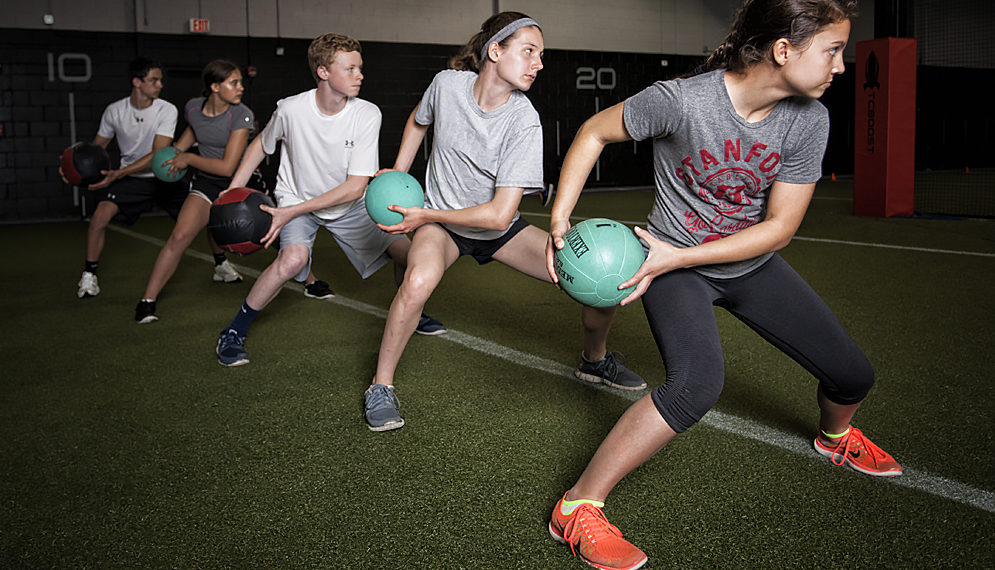
- Core and Landing: Prioritize plank variations and medicine ball throws, alongside teaching kids how to land softly from a jump to protect their knees.
Creating the Right Environment
The physical space for a youth program must be clear of hazards. Heavy free-weight zones should be cordoned off to prevent children from wandering near active adult lifters. Equipment should scale down to fit smaller frames; this includes utilizing fractional 1-kilogram plates, light aluminum training barbells (5–10 kg), and smaller-diameter handles on dumbbells and kettlebells to accommodate smaller hands and developing grips.